WJEC A-level Further Mathematics
SpecificationAS
Units 1–3Unit 1 Further Pure A5 papers · 7 packs
Topic question packs
NEWHand-sorted from the legacy FP1 papers (2008-spec WJEC modular FM, 2005–2017) into seven narrow single-topic packs across the four examinable 2017-spec Unit 1 sub-topics (2.1.1 Induction, 2.1.2 Complex Numbers, 2.1.3 Matrices, 2.1.4 Algebra & Series). Induction is split into series-sum proofs vs the remainder (divisibility, recursive sequences, matrix powers); Matrices is split into $3{\times}3$ operations vs 2D transformations; Algebra & Series is split into Vieta’s relations (roots of polynomials) vs standard $\Sigma$-sums + method of differences. The new spec also lists Further Vectors (3-D lines, planes, scalar product, perpendicular distances - 2.1.5) and complex-number loci / w = f(z) transformations under 2.1.2, but FP1 contained no 3-D vector questions and zero loci work, so those sub-topics have no legacy practice and are covered in the crib sheets instead. The $3{\times}3$ matrices pack actually maps onto Unit 4 (2.4.3) in the 2017 spec - Unit 1 keeps $2{\times}2$ inverses + 2D/3D transformations - but the algebraic technique is identical, so this pack doubles as Unit 4 practice. 2D transformations (pack T5) was the sparsest legacy topic with only 2 questions across the whole FP1 corpus.
Source questions © WJEC CBAC Ltd. Pack layout for revision purposes only.
Unit 2 Further Statistics A5 papers · 5 packs
Topic question packs
NEWHand-sorted from the legacy S2 and S3 papers (2008-spec WJEC modular FM, 2005–2017) into five narrow single-topic packs across the two examinable 2017-spec Unit 2 sub-topics (2.2.1 Random Variables / Poisson / Continuous RVs, 2.2.2 Regression / Correlation / Chi-Squared). The old "Random Variables & Linear Combinations" pack is split into discrete RV + sampling-distribution work (T1, from S3) versus pure linear-combinations problems on $U = XY$ (T2, from S2). Poisson (T3) and Continuous Uniform RVs (T4) keep their corpus but get tighter names. Linear Regression (T5) stands alone. The new-spec exponential distribution (2.2.1) had no legacy assessment in S2 / S3 and is documented in the T4 crib sheet only. Likewise, the new-spec Pearson product-moment, Spearman rank correlation, and chi-squared goodness-of-fit / contingency-table tests (all under 2.2.2) had zero questions in the legacy S3 corpus and are covered in the T5 crib sheet only - no separate question pack exists for them yet.
Source questions © WJEC CBAC Ltd. Pack layout for revision purposes only.
Unit 3 Further Mechanics A5 papers · 6 packs
Topic question packs
NEWHand-sorted from the legacy M2 and M3 papers (2008-spec WJEC modular FM, 2005–2017) and split into six narrow single-topic packs. 2017 spec 2.3.1 restricts momentum & impulse to the one-dimensional case - oblique / two-dimensional collisions live in the optional Unit 6 (2.6.2), not here. Topic 2 (Work, Energy & Power) covers KE / GPE / EPE conservation; Topic 3 isolates the pure Hooke’s-law statics (modulus calc and EPE at rest). Circular motion (2.3.3) splits into Topic 4 (horizontal circle, conical pendulum, banked tracks) and Topic 5 (vertical circles - complete-revolution conditions for strings vs rods, sphere problems). Topic 6 covers 2.3.4 (differentiation and integration of vectors in 2-D and 3-D, including relative motion and shortest-distance problems). Note: every legacy M2 W/E/P question is tied to elastic strings - pure W/E/P without elasticity is taught in Maths AS Unit 2.
Source questions © WJEC CBAC Ltd. Pack layout for revision purposes only.
A2
Units 4–6Unit 4 Further Pure B4 papers · 10 packs
Topic question packs
NEWHand-sorted from the legacy FP1, FP2, FP3 and M3 papers (2008-spec WJEC modular FM, 2005–2017) onto the 2017-spec Unit 4 topics. Unit 4 is the 120-mark A2 paper worth 35% of the qualification, covering 2.4.1–2.4.8. 2.4.1 (De Moivre, e^{iθ}, nth roots) and 2.4.2 (further trigonometry, t-formula, sum-to-product) come from FP2. 2.4.3 (3×3 matrix inverses, simultaneous-equation systems, geometric interpretation) sources from FP1. 2.4.4 is split into two single-topic packs: T4 Maclaurin / Taylor series (FP3) and T5 further partial fractions (FP2). 2.4.5 (further calculus - improper integrals, volumes of revolution, inverse-trig integration), 2.4.6 (polar coordinates) and 2.4.7 (hyperbolic functions) span FP2 and FP3. 2.4.8 (differential equations - integrating factor, auxiliary equation, CF + PI, coupled 1st-order systems) is sourced from legacy M3 because legacy FP2 / FP3 contained no DE work; the spec excludes mechanics contexts, but the algebraic technique is the same and the practice transfers directly.
Source questions © WJEC CBAC Ltd. Pack layout for revision purposes only.
Unit 5 Further Statistics B (optional)4 papers · 6 packs
Topic question packs
NEWHand-sorted from the legacy S2 and S3 papers (2008-spec WJEC modular FM, 2005–2017) into six narrow single-topic packs across the four examinable 2017-spec Unit 5 sub-topics (2.5.1–2.5.4). The old “Hypothesis Testing” pack is split into one-sample (T3, $z$- and $t$-tests on one mean) and two-sample / difference-of-means (T4). The old “Confidence Intervals & Estimation” pack is split into single-mean CIs (T5, normal and $t$) and large-sample CIs for proportions + difference of means (T6). T1 (2.5.1) keeps the merged sampling-distribution + unbiased-estimators content because every legacy S3 question is framed as “construct an unbiased estimator for parameter X using a sample” - the $\bar X$ sampling-distribution result and estimator theory are inseparable in the corpus. Mann-Whitney and Wilcoxon signed-rank tests are new in the 2017 spec and were not assessed in legacy S2 / S3, so they appear in the T3 crib sheet only. Correlation / regression / chi-squared sit in Unit 2 (2.2.2), not here.
Source questions © WJEC CBAC Ltd. Pack layout for revision purposes only.
Unit 6 Further Mechanics B (optional)4 papers · 6 packs
Topic question packs
NEWHand-sorted from the legacy M2 and M3 papers (2008-spec WJEC modular FM, 2005–2017) and split into six narrow single-topic packs. T1 covers 2.6.1 (rectilinear motion with variable forces - acceleration / velocity as a function of t, x or v). T2 covers 2.6.2 (vector momentum and impulse in two dimensions, including oblique collisions). T3 isolates moments, frameworks and rigid-body equilibrium (rods on pegs, hinged planks, non-uniform body COM via moments). T4 covers ladders + coplanar-force equilibrium (2.6.4). T5 is pure SHM (2.6.5 - amplitude, period, energy, spring-mass models), separated from T6, which holds the small set of 2nd-order linear DE questions (CF + PI technique, kitchen-scales damping model). Uniform-lamina COM questions (triangles, rectangles, semicircles) lived in legacy M1 which is not in this source set, so the rigid-body / lamina techniques sit in the T3 crib sheet rather than as a standalone pack. Variable-mass problems (rockets, raindrops) are absent from the legacy M2/M3 corpus.
Source questions © WJEC CBAC Ltd. Pack layout for revision purposes only.
More past papers
PMT collates WJEC Further Maths past papers including 2022–2024 sittings:
For pre-2017 papers, Jack Tilson's archive covers the old specification:
Stuff that helped me revise Calculators, books, flashcards · affiliate links
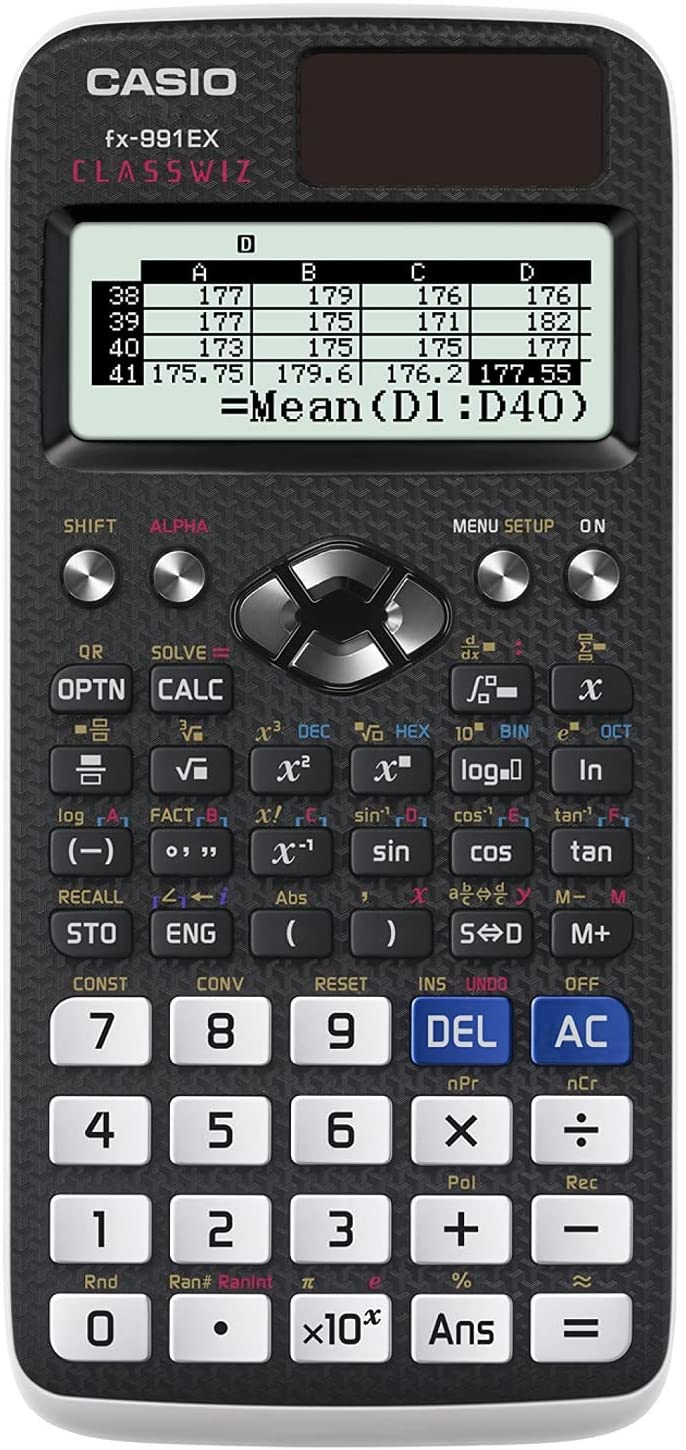
The non-negotiable. If you're walking into a Further Maths paper without one, good luck.
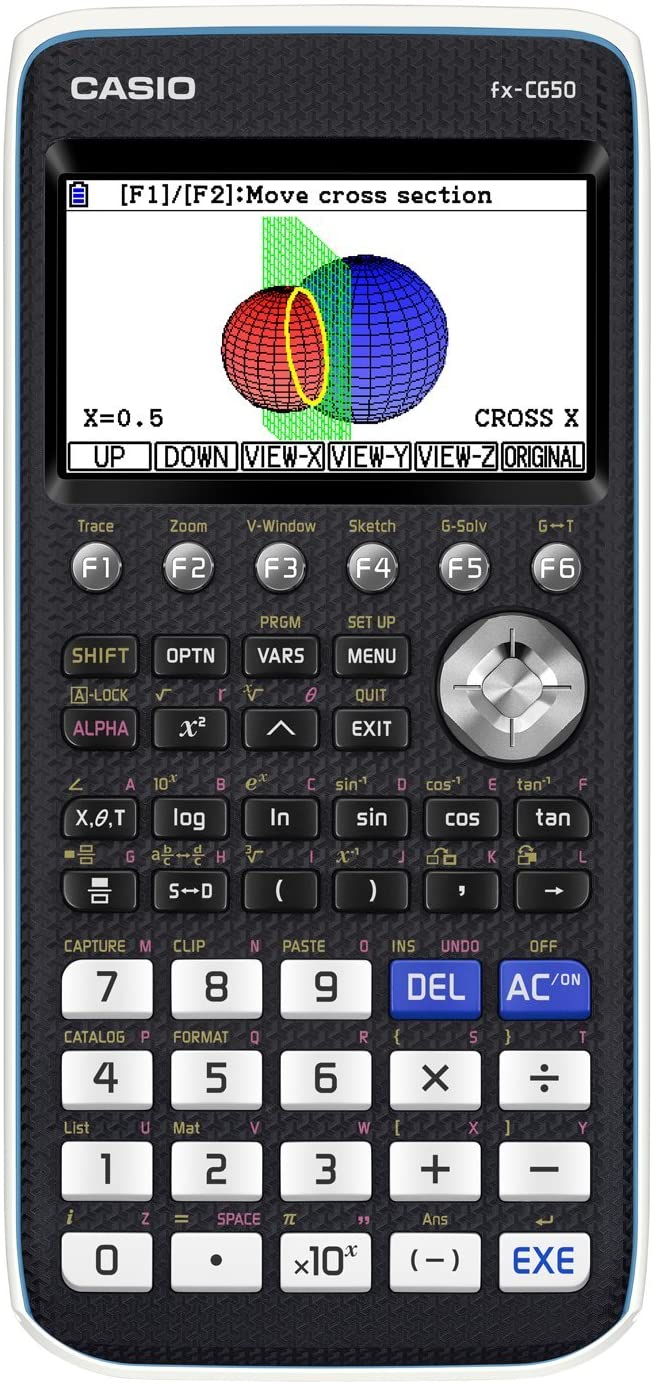
Pricier but worth it for Further Maths - sketches anything, including polar curves. Free marks.
Not WJEC, but the topics overlap enough to be useful for the pure and applied content.
The GOAT notebook for maths. The squares come through.

More reliable than the one they hand out in the exam.
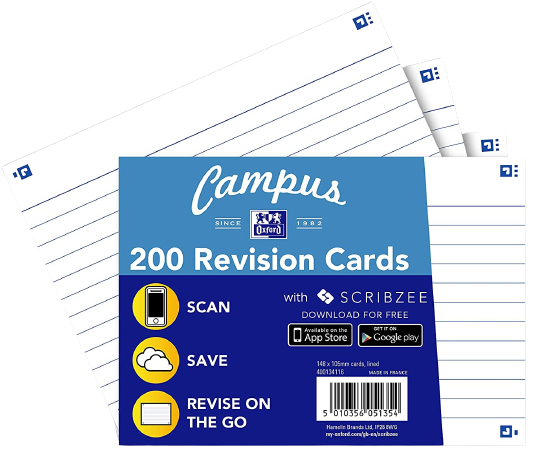
Physical flashcards with Scribzee scanning so you can use them on the app too.
© 2026 revise.wales · WJEC owns all spec, past paper and mark scheme content.